28 Feb 2023
SA Flag

CGA calls for urgent political intervention to ensure South African oranges continue to be exported to EU in 2023

The Citrus Growers Association of South Africa (CGA) has written to Minister of Trade, Industry and Competition, Ebrahim Patel requesting that he urgently calls for the establishment of a World Trade Organisation (WTO) Panel to adjudicate on the new False Coddling Moth (FCM) regime governing the importation of South African oranges to the EU region. If the issue is not resolved before the 2023 export season kicks off, growers could face hundreds of millions in losses putting the future sustainability of the entire industry at risk.

READ MORE

28 Feb 2023
Cover Crops

Improve soil health with cover crops

Cover crops support soil health by increasing soil carbon – organic matter – which stimulates microbial activity and improves soil structure.

The impact of cover crops on soil health was discussed at a workshop facilitated by the World Wide Fund for Nature (WWF) held at Oak Valley in Grabouw in August. Ivan Jansen van Rensburg from Barenbrug described eight soil-health benefits of cover crops: sequestering carbon, supporting microbes, suppressing diseases, fixing nitrogen, suppressing weeds, preventing erosion, building structure, and improving aeration and infiltration. Different cover crops have different strengths, so diversity is important. For example, radish roots muscle into the soil, breaking up compaction, enabling water movement. But Jansen van Rensburg pointed out that the finer roots of cereals are as useful as the large roots of radishes.

READ MORE

28 Feb 2023
Citrus Thinning by hand.

Thinning effects on Citrus Yield and Fruit Size

Thinning is performed in Citrus to increase fruit size and thus to enhance the market value of the crop. Fruit count is reduced and crop yield may be either unchanged or markedly reduced depending on the thinning procedure used.

The sink strength of the fruitlets, which determines fruitlet growth rate, is largely determined during the early stages of development. It may be increased reducing flower formation through the application of gibberellic acid during the winter rest period. In some cultivars this reduction in flower number results in an increase in the size of the ovaries and a faster early fruitlet growth rate. Also, the application of a synthetic auxin at flower opening increases selectively in most cultivars the sink strength of some of the ovaries. In both cases, the final number of fruits set is reduced in an indirect way and final fruit size is increased. Crop yield is not affected significantly.

READ MORE

23 Jan 2023
Using gibberellic acid sprays on navel oranges

Using Gibberellic Aid Sprays on Navel Oranges

The use of gibberellic acid (GA) is one of the most effective management tools available to citrus growers to improve rind quality and delay rind aging. Appropriate use of GA can result in better packouts and market outturns. Applying GA can be a costly exercise in terms of time and money, so it needs to be done right. this Primefact outlines how to get the most out of your GA sprays by providing information to help you decide when and how to apply GA to navel oranges.

READ MORE

23 Jan 2023
Pre-harvest splitting of Citrus

Pre-Harvest Fruit Splitting of Citrus

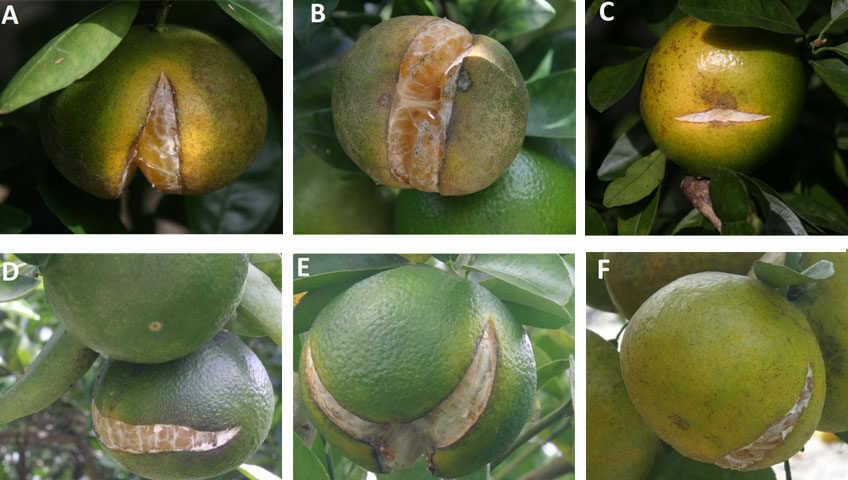
Under specific conditions, the fruit on citrus trees will split open. The damaged fruit is unmarketable and provides a habitat for fungal and insect pests that can reproduce and then damage currently marketable fruit. Losses of 30 to over 50 percent of the crop are possible with some cultivars. This is a physiological disorder that starts with nutrient imbalances at flowering that result in mechanically weak areas in the rind. These rupture if interior parts of the fruit expand faster than the peel can stretch.

READ MORE

23 Jan 2023
Effect of Manual Fruit Thinning on Yield and Fruit Quality of Clementine Mandarin

Effect of Manual Fruit Thinning on Yield and Fruit Quality of Clementine Mandarin

The effect of fruit thinning time and thinning rate on flowering, fruit yield and fruit quality of clementine trees (Citrus clementine Hort. ex Tanaka) was investigated during three successive seasons 2017/2018, 2018/2019 and 2019/2020. Data recorded only during 2018/2019 and 2019/2020 seasons. Thinning applied at three different times on 1st June, 15th June and 30th June. Fruit thinning rate were performed when the fruit diameter reached about 25-30 mm, as hand thinning by removing 0, 25 or 50% of fruit number/shoot per tree.

READ MORE

25 Nov 2022
Fruit size in Star Ruby Grapefruit.

The usage of auxins with various cultural techniques to increase fruit size in Star Ruby Grapefruit

Fruit size is a key parameter for quality and increases the profitability for export markets in citrus production in Turkey. Fruit size can be enhanced by several techniques such as girdling and thinning. Various plant growth regulators are known to affect the growth and size of citrus fruit. Thus the effects of synthetic auxin applications (2,4-DP and 3,5,6-TPA) at different physiological periods, girdling practices, pruning practices, foliar application of potassium and various combinations of these practices on the fruit size and yield, fruit retention rate, and leaf chlorophyll concentration and fluorescence of Star Ruby grapefruit cultivar were investigated.

READ MORE

25 Nov 2022
Trunk girdling in Marisol Clementines.

The effect of combined deficit irrigation and summer trunk girdling on the internal fruit quality of ‘Marisol’ Clementines

The influence of girdling, deficit irrigation, and a combination of girdling and deficit irrigation on fruit quality of ‘Marisol’ Clementines was investigated over two seasons, 1998 and 1999, at two different sites in South Africa. Girdling increased the total soluble solids (TSS) by 2-10%,however, the effect was not always significant. There were no trends observed for external fruit colour, fruit diameter, juice content (%), titratable acidity (TA) and TSS:TA ratios due to girdling.

READ MORE