With current drought conditions being experienced in the North West, Free State, Kwa-Zulu Natal and Mpumalanga, the South African irrigation farmer is, now more than ever, faced with the problem of “how to produce more, with less”, and to make every drop count.
In order to manage our strained water resources, as well as practice good environmentally sustainable practices, farmers rapidly have to introduce new technologies to improve their efficiencies and yields. In the irrigation farming environment, irrigation scheduling appears to be the most popular and cost effective way to achieve just that.
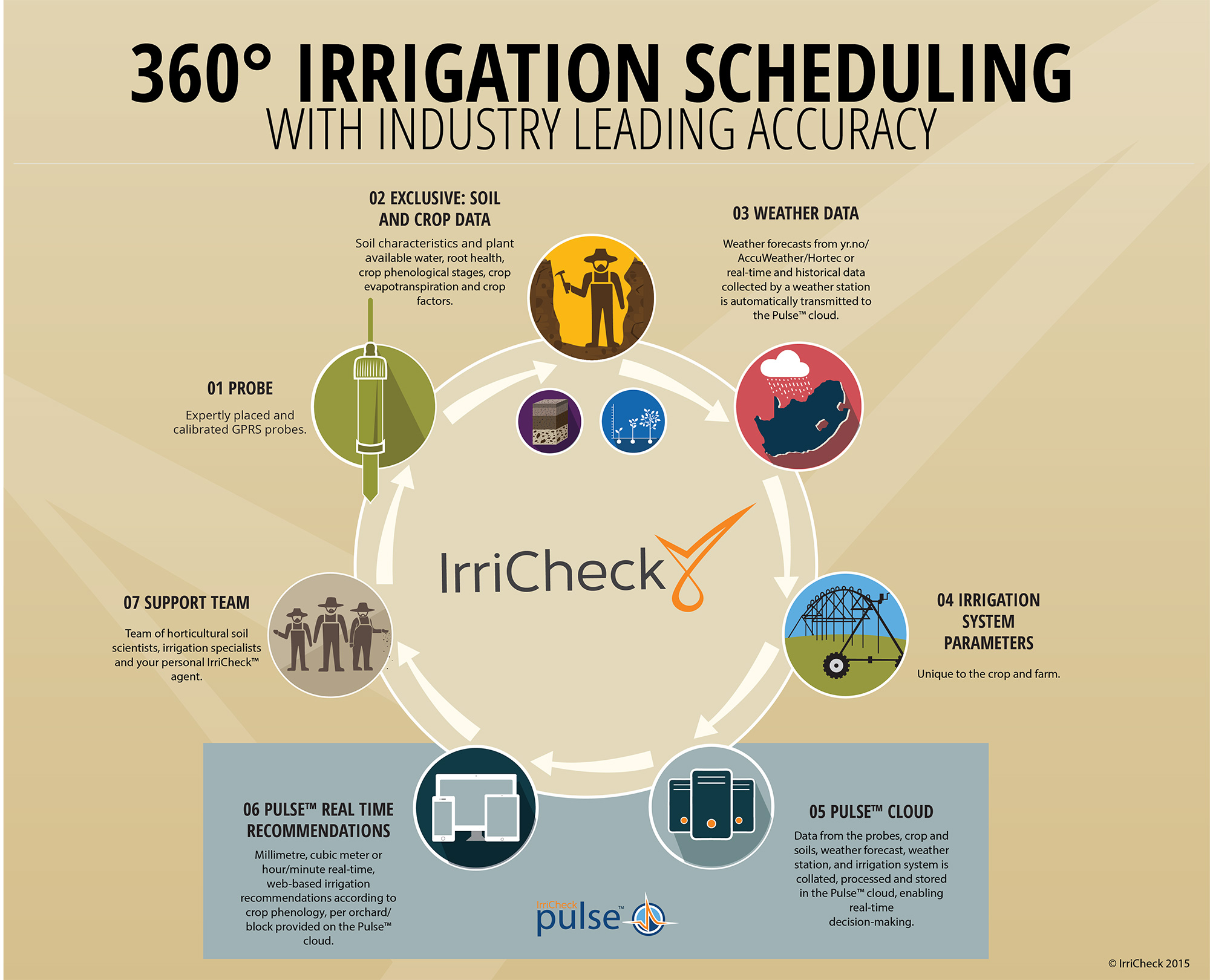
Irricheck™ is independent of hardware manufacturers, however, prescribe that the most efficient irrigation scheduling hardware in use currently is the continuous logging soil moisture capacitance probe, coupled to a GPRS unit, in order to measure live soil-moisture content and temperature data.
In terms of software, systems need to take into account how technology has developed. An efficient scheduling system should, at least, have the ability to measure and analyze:
- Soils: Each soil’s unique boundaries in terms of water holding capacity, including, Field Water Capacity (FWC), Permanent Wilting Point (PWP) and Readily Available Water (RAW). Most importantly, is that the system should indicate soil water data in millimeters of water and probes should therefore be calibrated to millimeters per meter water holding capacity in each field.
- Crop specific water needs: The software should accurately simulate crop evapotranspiration under non-specific conditions, using the dual crop co-efficient approach, taking into consideration daily water loss in the form of evapotranspiration from the crop and evaporation from the soil under specific, in situ climatic conditions. Due to changing management practices, crop phenology and climatic conditions, the software should also be able to automatically determine the crop evapotranspiration and changing crop coefficients according to these changing conditions for scheduling purposes.
- Climatic parameters: Because atmospheric evaporative demand is the driving force in crop water use, it is important that an accurate weather forecast is used for predicting irrigation needs for the coming week and that actual weather data is measured accurately, ideally making use of an on-farm weather station.
- Irrigation systems: The parameters of the irrigation system, via input data, should be taken into consideration in order for the software to adjust to the limitations of your irrigation system, different soil types, unique environmental conditions and plant specific requirements.
- Recommendations: Recommendations should be live and in real-time (data should be sent automatically to the software) and in practical units, like millimeters, cubic meters or hours and minutes, and should be provided at least a week in advance. This allows the farmer to make quick decisions and plan ahead.
Recommendations should also be available on mobile applications for easy access, anywhere, anytime.
And finally, data should be hosted in an on-line web based system in order to allow simultaneous access to relevant parties needing to analyze data, have control over delegated responsibilities and allow for support by consultants. Unfortunately, not all technologies are able to do this and while we are all aware of scheduling graphs, it’s “what lies beneath” these graphs in terms of data that is absolutely critical and largely miss-understood.
Irricheck specializes in scheduling software and services, such as their proprietary software, Irricheck Pulse™, which provides real time live recommendations having taken into account and analyzed all the required factors and data above and which is built into the software. Pulse™ has been in development since 1994, by agronomists, and is proudly South African. Farmers in South Africa who have employed the basic systems have experienced reduced pumping hours by as much as 15% opposed to their traditional methods with accompanying savings in water and electricity costs. However, with the use of Irricheck’s specialized systems, this could be increased to 30% plus in savings as well as much better utilization of nutrients.
In addition to the savings above, plants in general react significantly better to these favorable, healthy soil conditions, particularly oxygen rich soils with better microbial activity and less leaching of nutrients. Under these conditions yields, but even more so quality, is generally increased, and what better way is there of handling increased costs, than by increasing yields?
For more information visit www.irricheck.co.za or phone 021 300 0425.
To download the Irrigation schedule at full size click here.